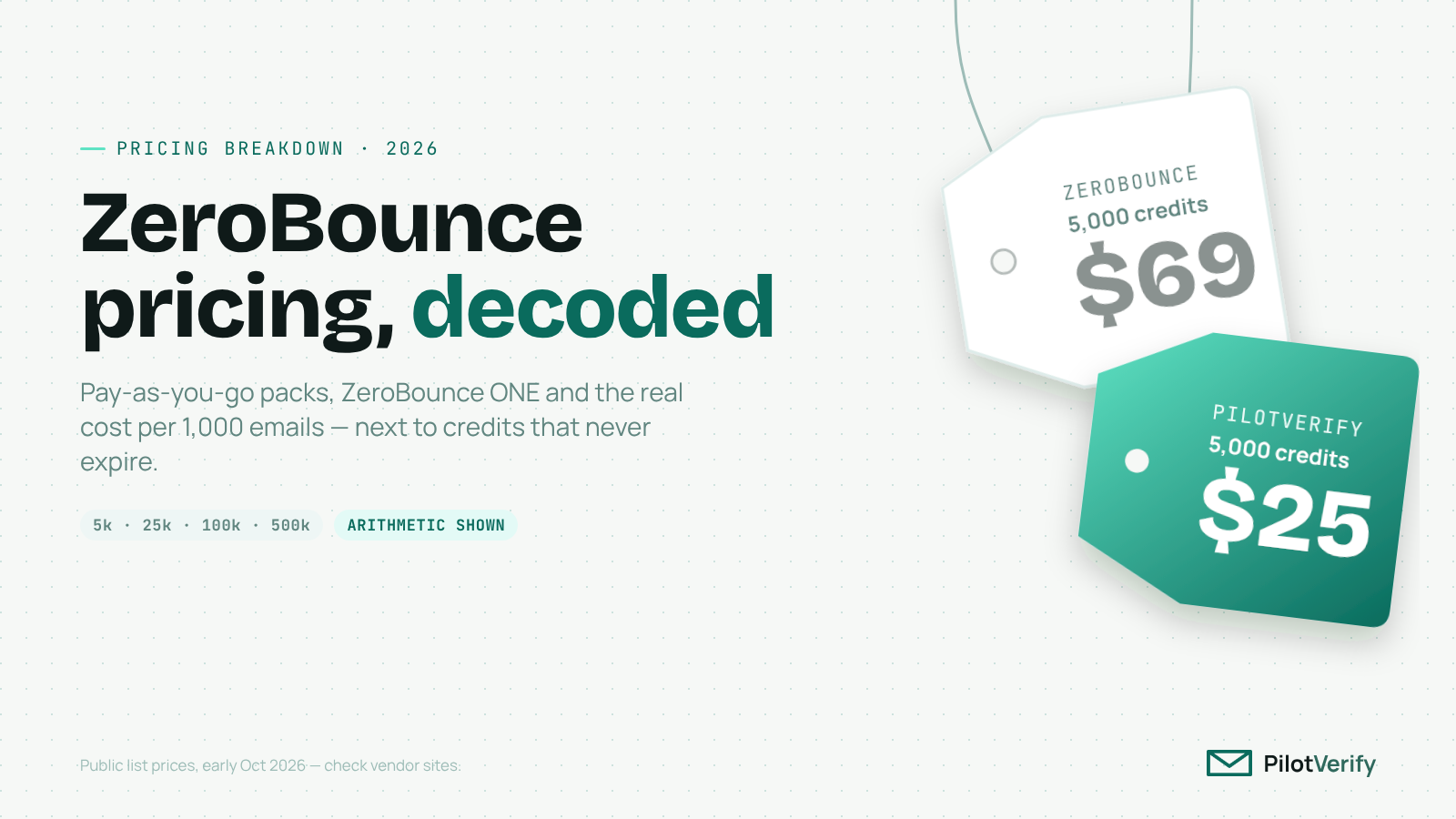
If you are budgeting for email verification this year, ZeroBounce is probably on your shortlist. It is one of the best-known names in the category, and for good reason. But ZeroBounce pricing is split across pay-as-you-go credit packs and a monthly subscription called ZeroBounce ONE, and the cost per email changes a lot depending on how many you buy and how you buy them.
This post lays out what ZeroBounce actually charges in 2026, works out the cost per 1,000 emails at four common volumes, and puts those numbers next to PilotVerify's one-time credit packs. We wrote it, so we have a stake in the answer. We have tried to keep the arithmetic visible so you can check every line yourself.
$69 is what ZeroBounce charges for 5,000 pay-as-you-go credits. The same 5,000 credits cost $25 on PilotVerify's Starter pack.
Pricing note: Competitor prices checked from public pricing pages in early October 2026 — confirm on the vendor's site before buying.
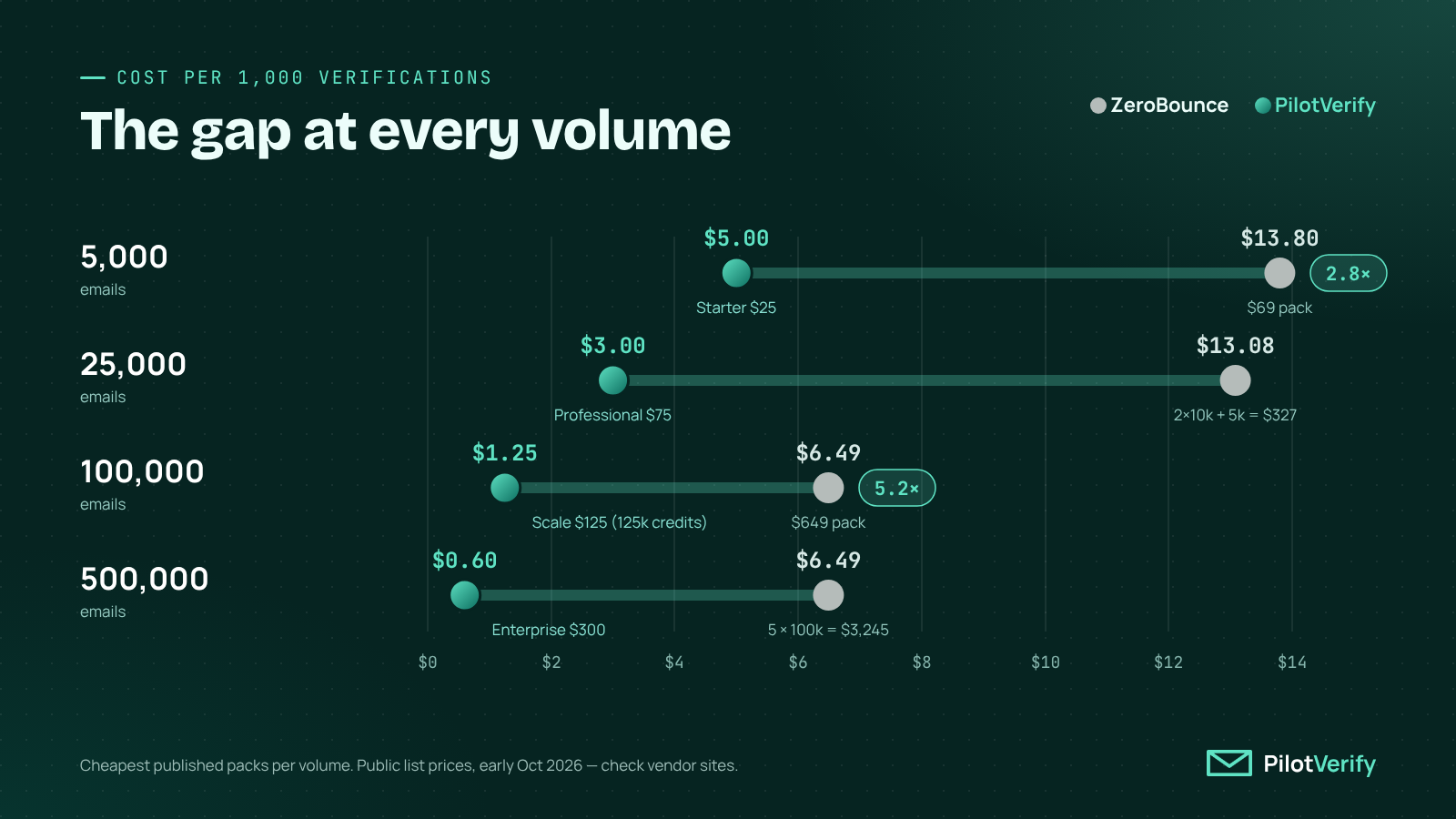
Figure: Cost per 1,000 verifications at four volumes. ZeroBounce runs $13.80 to $6.49; PilotVerify runs $5.00 to $0.60, using the cheapest published packs.
ZeroBounce Pricing at a Glance: The Pay-As-You-Go Tiers
ZeroBounce sells credits in fixed packs. One credit verifies one email. The smallest pay-as-you-go purchase is 2,000 credits, so there is no way to buy a few hundred checks on their own. Here are the published tiers we checked, with the cost per 1,000 worked out:
| ZeroBounce pack | Price | Arithmetic | Cost per 1,000 |
|---|---|---|---|
| 2,000 credits (minimum) | $39 | $39 ÷ 2 | $19.50 |
| 5,000 credits | $69 | $69 ÷ 5 | $13.80 |
| 10,000 credits | $129 | $129 ÷ 10 | $12.90 |
| 100,000 credits | $649 | $649 ÷ 100 | $6.49 |
| 1,000,000 credits | ≈ $3,199 | $3,199 ÷ 1,000 | ≈ $3.20 |
ZeroBounce pricing has a steep volume curve. Going from 5,000 to 100,000 credits roughly halves the per-email price, and the 1 million pack halves it again. That rewards teams that buy big up front, which is fine if you know you will use the credits.
There is also a free account that includes 100 free credits per month. That is enough to test the API or spot-check a few addresses, not enough to clean a list.
Do ZeroBounce credits expire?
It depends on when you opened your account. Credits never expire for accounts created on or before June 1, 2026. For newer accounts, purchased credits are valid for at least two years. That is still a generous window, but it is a change worth knowing about if you are signing up now. Check current terms on ZeroBounce's site before you buy a large pack.
What Is ZeroBounce ONE and Who Is It For?
ZeroBounce ONE is the subscription option. It starts at $99 per month, or $79 per month billed annually, and includes 10,000 credits a month plus ZeroBounce's deliverability tools. According to the plan comparison on PilotVerify's own pricing page (September 2026), ONE includes 1 DMARC domain and 10 blacklist monitors at that entry level.
If you count only the credits, the math looks like this:
· Monthly billing: $99 ÷ 10 = $9.90 per 1,000 verifications
· Annual billing: $79 ÷ 10 = $7.90 per 1,000 verifications
· Yearly spend: $1,188 on monthly billing, or $948 on annual billing
Of course, you are not paying only for credits. ONE bundles monitoring and other deliverability features, and for some teams that bundle is the reason to buy.
ZeroBounce ONE vs PilotVerify Complete
PilotVerify's closest equivalent is the Complete bundle at $39 per month. It includes 10,000 validation credits a month plus everything in our Pro deliverability plan. Here is how the two entry points line up:
| Feature | ZeroBounce ONE (entry) | PilotVerify Complete |
|---|---|---|
| Monthly price | $99 ($79 billed annually) | $39 |
| Verification credits per month | 10,000 | 10,000 |
| Credit-only cost per 1,000 | $9.90 ($7.90 annual) | $3.90 |
| DMARC domains | 1 | 10 |
| Blacklist monitors | 10 | 50 |
| Other inclusions | ZeroBounce deliverability tools | 12-month history, API access, webhook & Slack alerts |
| Yearly spend | $1,188 ($948 annual) | $468 |
The PilotVerify number is $39 × 12 = $468 a year. If you mainly want verification plus DMARC monitoring and blacklist monitoring, Complete covers more domains for less. If you rely on ZeroBounce's wider suite, the comparison is not like for like.
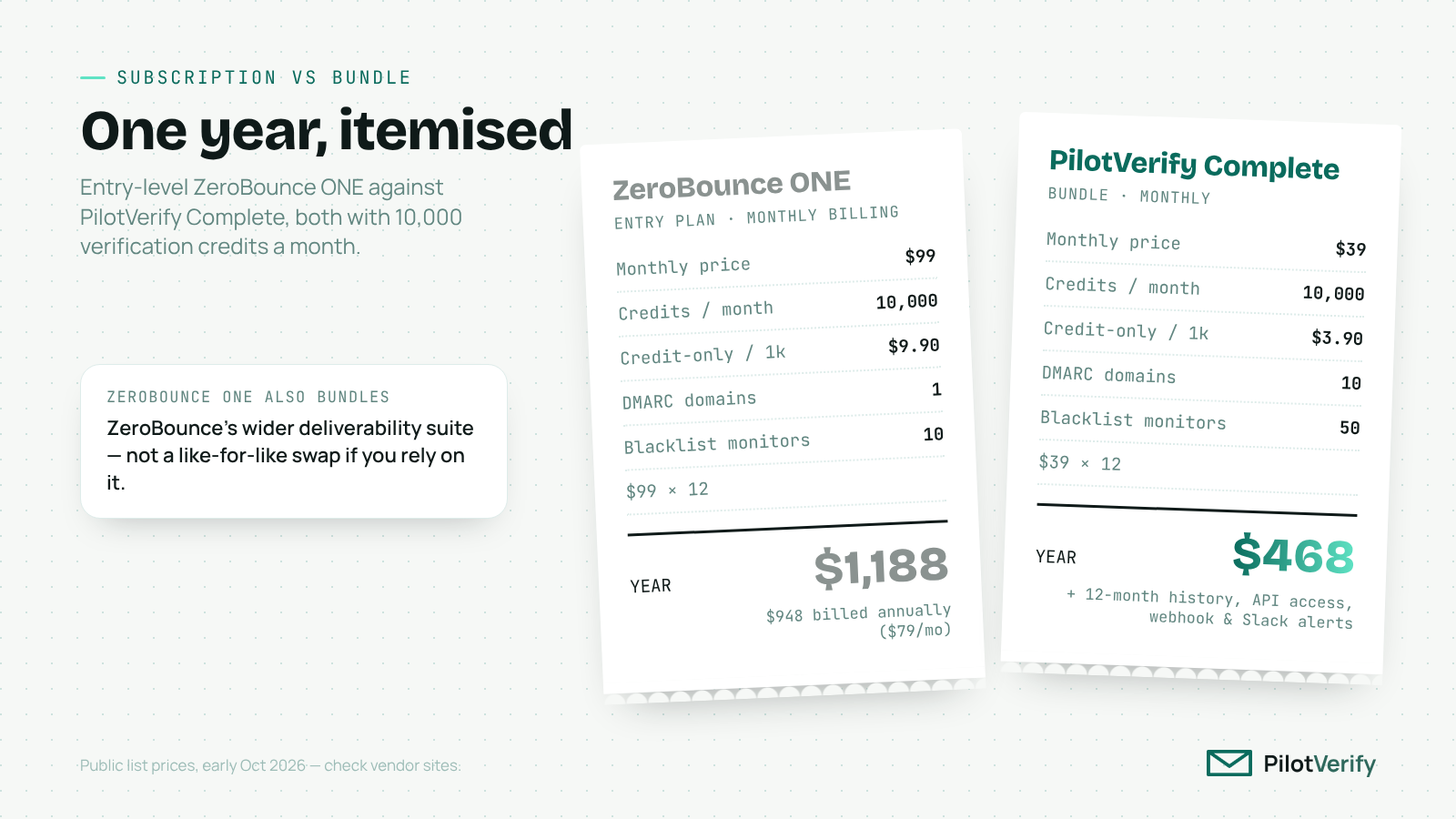
Figure: One year itemised. ZeroBounce ONE (entry, monthly) totals $1,188 ($948 billed annually); PilotVerify Complete totals $468, with 10 DMARC domains and 50 blacklist monitors.
ZeroBounce Cost per Email vs PilotVerify: The Math at Four Volumes
This is the part of ZeroBounce pricing most people never work out. For each volume below we used the cheapest way to cover it with the packs each vendor publishes. Where a volume doesn't match a published ZeroBounce tier, we show exactly how we built it.
PilotVerify's credit packs are one-time purchases with no subscription: Starter $25 for 5,000, Professional $75 for 25,000, Scale $125 for 125,000, and Enterprise $300 for 500,000. Full details are on the PilotVerify pricing page.
| Volume | ZeroBounce (how we got it) | ZB per 1,000 | PilotVerify (how we got it) | PV per 1,000 |
|---|---|---|---|---|
| 5,000 | 5,000 pack = $69 | $69 ÷ 5 = $13.80 | Starter = $25 | $25 ÷ 5 = $5.00 |
| 25,000 | 2 × 10,000 ($258) + 1 × 5,000 ($69) = $327 | $327 ÷ 25 = $13.08 | Professional = $75 | $75 ÷ 25 = $3.00 |
| 100,000 | 100,000 pack = $649 | $649 ÷ 100 = $6.49 | Scale (125,000 credits) = $125 | $125 ÷ 100 = $1.25 used ($1.00 bought) |
| 500,000 | 5 × 100,000 = $3,245 | $3,245 ÷ 500 = $6.49 | Enterprise = $300 | $300 ÷ 500 = $0.60 |
Two caveats make this table fairer to ZeroBounce:
· 25,000: our checked list didn't include a 25,000 tier, so we stacked the published packs. ZeroBounce may offer intermediate tiers on its pricing page, which would lower that figure. Use its calculator for your exact number.
· 500,000: buying the 1 million pack (≈ $3,199) is slightly cheaper than five 100k packs, and gives you twice the credits. If you will use all of them, that works out to about $3.20 per 1,000, which narrows the gap a lot.
Even with both adjustments, PilotVerify's packs cost less at each of these four volumes. At 5,000 emails, ZeroBounce costs about 2.8 times as much ($69 vs $25). At 100,000 it is about 5.2 times ($649 vs $125).
💡 Developer Tip: Every PilotVerify credit is used the same way, whether the result comes back VALID, INVALID or RISKY. When you compare vendors, ask each one how unknown or retried results are charged, so your cost per 1,000 matches what you actually pay.
When ZeroBounce Pricing Is Worth It
Price per email is not the only thing that matters. There are good reasons to pay more for ZeroBounce:
· You want one mature deliverability suite. ZeroBounce combines verification, monitoring and related tools in one platform.
· You use AI scoring. ZeroBounce offers AI-based scoring, which can help when you are deciding what to do with uncertain addresses.
· Activity data matters to you. ZeroBounce provides activity data alongside verification results.
· Your stack depends on a specific integration. Its integration list is large, and a strong brand makes internal sign-off easier for some teams.
If those features save your team hours each month, the higher price can be justified. Just make the decision on purpose, not by default.
When a ZeroBounce Alternative Is Cheaper
PilotVerify is built for teams that mainly need fast, accurate verification and want to pay only for what they use. It tends to come out ahead when:
· Your volume is irregular. Credits never expire, there is no subscription and no auto-renewal. A quarterly list clean doesn't need a monthly plan.
· You buy in the 5,000 to 500,000 range. The table above shows the gap at every step.
· You verify at the point of signup. PilotVerify reports 99.6% accuracy with a sub-100ms average response, so checks can run inline on a form.
· You want to start free. New accounts get 1,000 free verification credits, versus 100 a month on ZeroBounce's free account.
· You need predictable billing. When credits run out, the API returns an insufficient-credits error. Nothing is charged automatically.
Under the hood, each check covers RFC 5322 syntax (including Unicode domains), MX/DNS lookup, disposable detection, optional SMTP mailbox verification, catch-all detection and role-based flagging. See the full list on the features page.
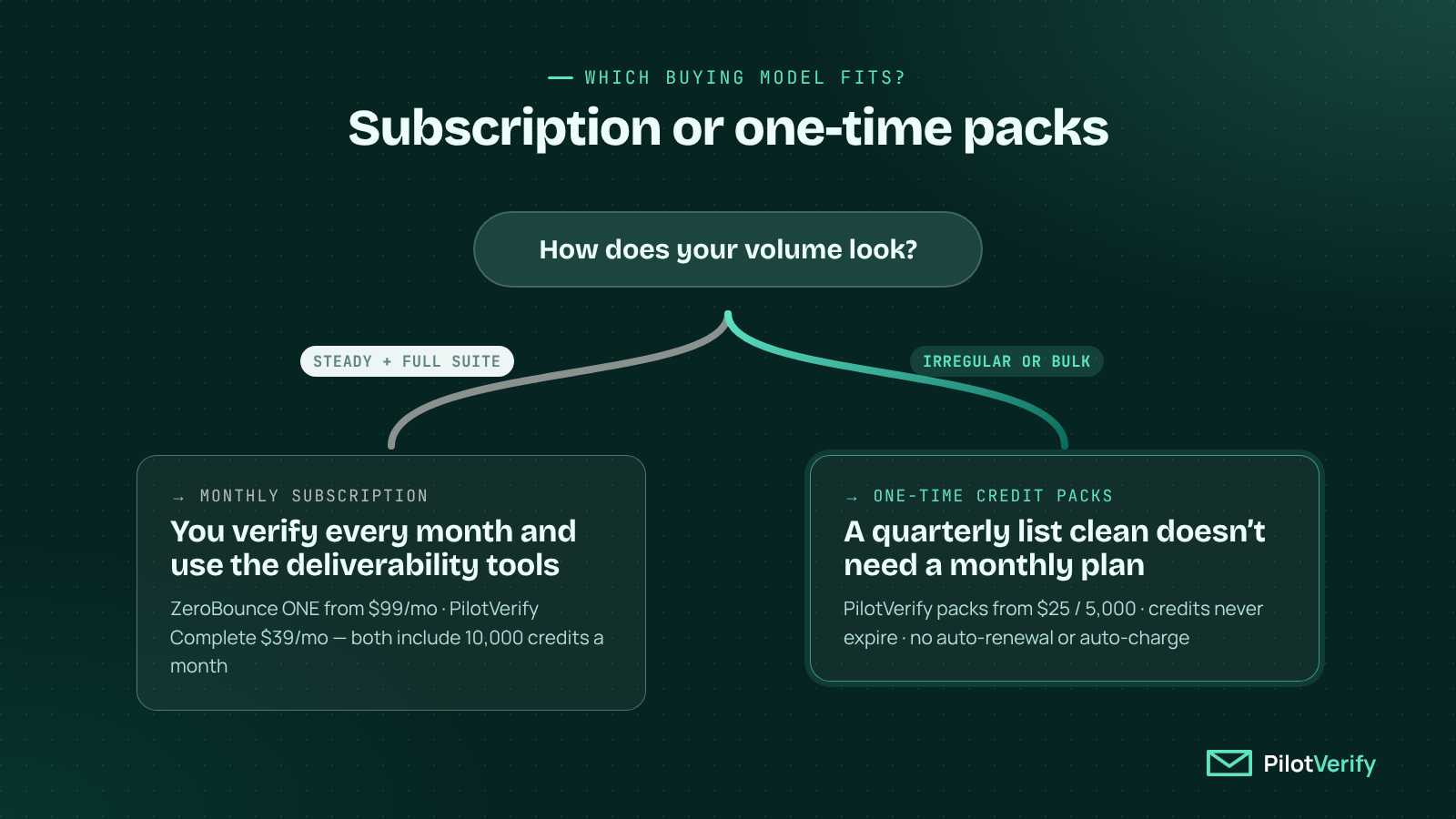
Figure: Steady monthly volume plus regular use of deliverability tools suits a subscription; irregular or bulk volume suits one-time credit packs that never expire.
Where Neither ZeroBounce nor PilotVerify Is Cheapest
Honesty matters more than a clean sweep. If all you want is the lowest bulk-cleaning price, other vendors deserve a look:
| Vendor | Sample price | Cost per 1,000 | Credit expiry |
|---|---|---|---|
| PilotVerify | $300 / 500,000 | $0.60 | Never |
| ZeroBounce | $649 / 100,000 | $6.49 | Never (older accounts) / at least 2 years (newer) |
| NeverBounce | $8 / 1,000 pay-as-you-go | $8.00, falling to about $2.00 at very high volume | 12 months |
| Kickbox | $500 / 100,000 | $5.00 | 12 months |
| MillionVerifier | ≈ $449 / 1,000,000 | ≈ $0.45 | Never |
MillionVerifier is cheaper than PilotVerify at very high volume: about $0.45 per 1,000 at the 1 million tier versus our $0.60 at 500,000. Its focus is budget bulk cleaning, and its real-time API is less of a priority. Check MillionVerifier's pricing if bulk price is your only criterion.
NeverBounce has strong CRM sync with Salesforce, HubSpot and Marketo, and Kickbox has a polished UI and its Sendex quality score. Both expire pay-as-you-go credits after 12 months, which matters if you buy ahead. For a wider list, see our roundup of ZeroBounce alternatives.
How to Work Out Your Own Verification Cost
Before you commit to any vendor, take ten minutes to run your own numbers:
· Count real volume. Add your monthly signups, imports and planned list cleans. Lists decay steadily — commonly estimated at around 20–25% a year — so plan for re-verification, not just new addresses.
· Match the pack to the volume. Pick the cheapest combination that covers a year, not a month.
· Check expiry. A cheap pack that expires before you use it is not cheap.
· Separate verification from monitoring. Decide whether you need a deliverability bundle, or just credits.
· Test on your own data. Run a sample through each tool's free credits and compare how it labels risky addresses.
For the bigger picture on why this spend pays back, our guide on how to reduce your email bounce rate covers the targets to aim for: under 2% is healthy, and under 1% is the goal.
Frequently Asked Questions (FAQ)
Q: How much does ZeroBounce cost per email in 2026?
A: On the published pay-as-you-go tiers, it ranges from $0.0195 per email at the 2,000-credit minimum to about $0.0032 at the 1 million tier. At 100,000 credits it is $0.00649 per email.
Q: What is the minimum purchase under ZeroBounce pricing?
A: The smallest pay-as-you-go pack is 2,000 credits for $39. The free account includes 100 credits per month.
Q: Is ZeroBounce ONE worth it?
A: It can be if you will use its deliverability tools every month. If you mostly need verification credits, the credit-only cost is $9.90 per 1,000 on monthly billing, which is higher than its larger pay-as-you-go packs.
Q: Is PilotVerify always cheaper than ZeroBounce?
A: At the volumes we compared (5k, 25k, 100k and 500k) PilotVerify's packs cost less. But PilotVerify is not the cheapest option everywhere: MillionVerifier is cheaper at very high volume.
Q: Do PilotVerify credits expire?
A: No. Credit packs are one-time purchases, credits never expire, and there is no subscription, auto-renewal or auto-charge.
Q: Can I try PilotVerify before buying?
A: Yes. New accounts get 1,000 free verification credits, and you can test single addresses with the free email verifier. API details are in the PilotVerify docs.
The Bottom Line on ZeroBounce Pricing
ZeroBounce is a strong, mature product, and its pricing reflects a full deliverability platform. If you use that platform, the premium can make sense. If you mainly need accurate verification at a predictable price, the numbers above show you can pay several times less with PilotVerify, with credits that never expire. Run your own volume through the tables, check current terms on each vendor's site, and pick the model that fits how you actually send.
Try PilotVerify Free — get 1,000 free verification credits at pilotverify.net