NeverBounce is an established email verification service and remains a solid choice for many teams. But if you buy credits in bulk and use them slowly, or you are rethinking your stack, it is worth seeing what else is out there. This guide compares six NeverBounce alternatives on the things that actually change your bill: price per 1,000 emails, credit expiry, free credits and how each one handles real-time API checks.
A quick disclosure: PilotVerify publishes this blog, and PilotVerify is one of the six. We have listed each tool's real strengths and said plainly where another vendor beats us.
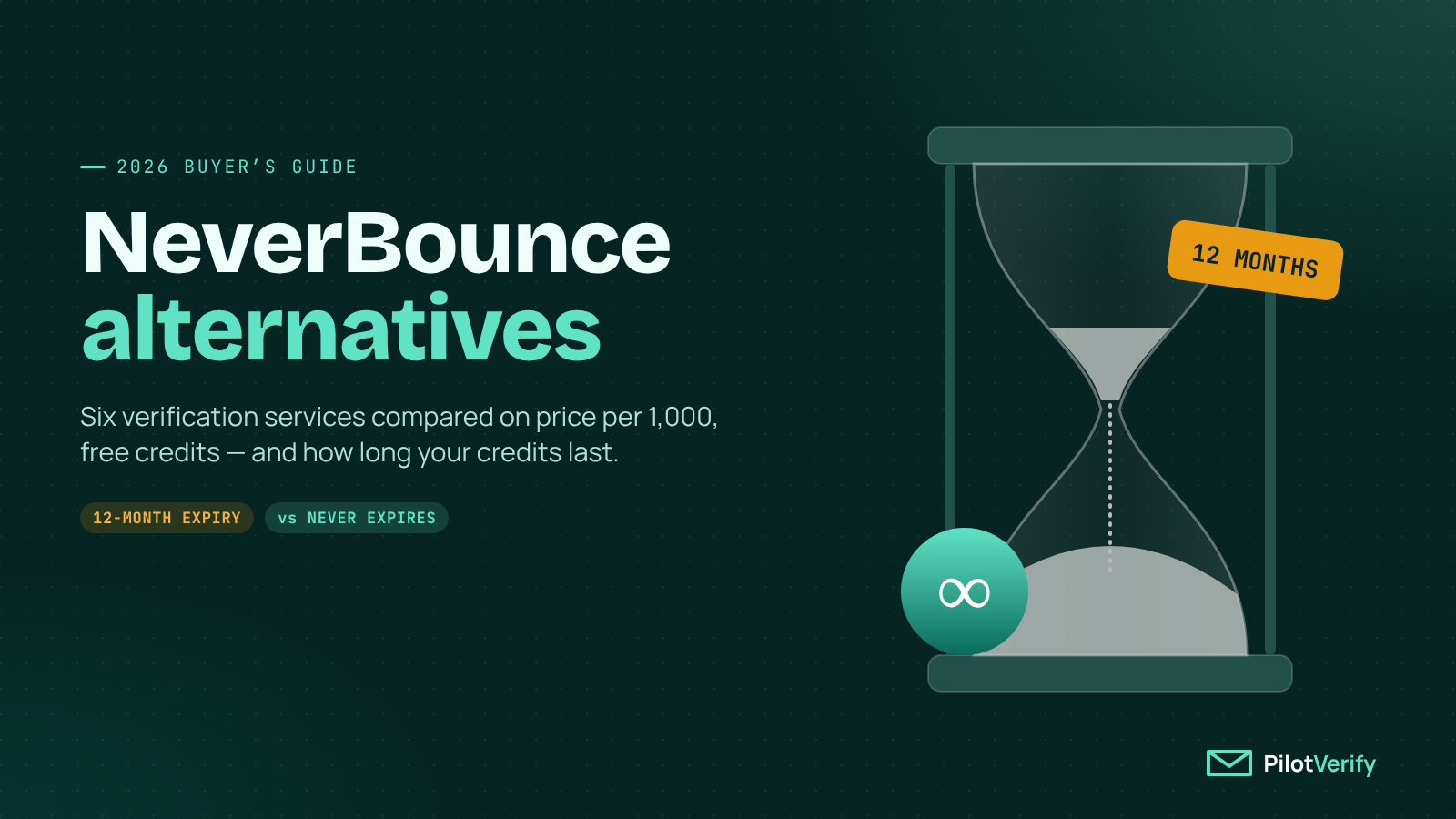
12 months is how long NeverBounce pay-as-you-go credits stay valid after purchase.
Pricing note: Competitor prices checked from public pricing pages in early October 2026 — confirm on the vendor's site before buying.
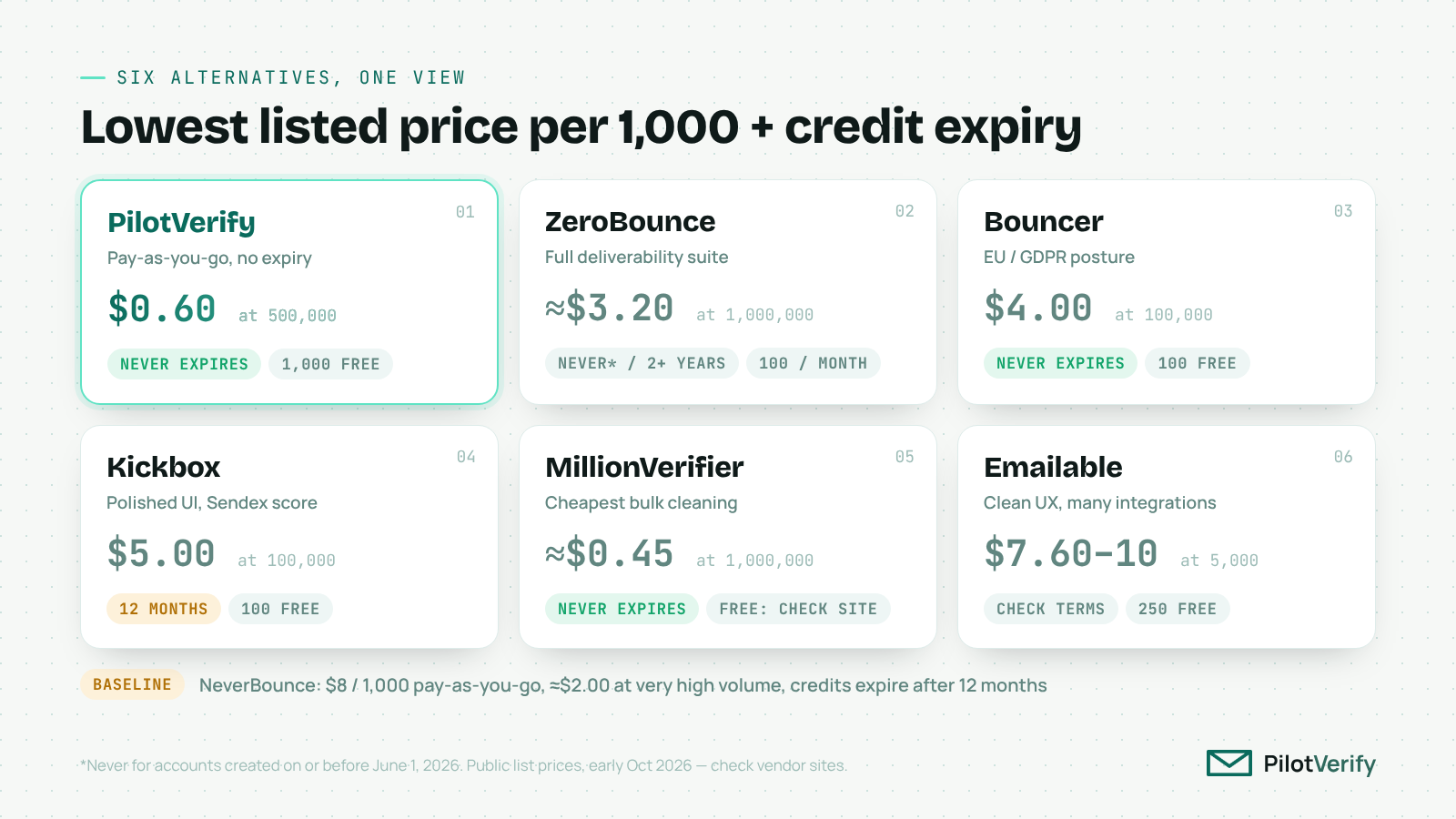
Figure: The six alternatives at a glance, with lowest listed price per 1,000, credit-expiry terms and free credits, against the NeverBounce baseline.
Why Teams Look for a NeverBounce Alternative
Most people don't switch because NeverBounce stopped working. They switch because the pricing model stopped fitting how they verify. The three common triggers:
1. Credit expiry
NeverBounce pay-as-you-go credits expire 12 months after purchase. If you clean a list once or twice a year, or you bought a large pack to get a better rate, unused credits can lapse. For quarterly cleaners this is often the deciding factor.
2. Per-email price at small and mid volumes
The NeverBounce pricing page lists pay-as-you-go at $8 per 1,000 ($0.008 per email), with volume tiers falling to about $0.002 at very high volume. There is also a Growth plan at $49 per month for up to 10,000 emails. That is competitive for some teams, but several alternatives below cost less at the same volumes.
3. Ownership and roadmap fit
NeverBounce is owned by ZoomInfo. That is simply a fact worth knowing when you assess any vendor's direction and contract terms. Whether it matters to you depends on your own procurement process.
None of this makes NeverBounce a bad choice. It is established, it has strong CRM sync with Salesforce, HubSpot and Marketo, and it offers 80+ integrations. If those integrations are central to your workflow, staying may be the right call.
What to Look for in a NeverBounce Alternative
Before comparing names, decide what you are optimizing for. These are the criteria we used for each tool below:
· Price per 1,000 at the volume you actually buy, not the headline tier.
· Credit expiry — never, 12 months, or something in between.
· Free credits to test on your own data before buying.
· Real-time API if you verify at signup, and bulk upload if you clean lists.
· Extras such as deliverability monitoring or form protection, and whether they are billed separately.
If you want a deeper checklist of API capabilities, see our post on the top email validation API features.
The 6 Best NeverBounce Alternatives in 2026
1. PilotVerify — best for pay-as-you-go buyers who want credits that never expire
· Price: Starter $25 / 5,000 ($5.00 per 1k), Professional $75 / 25,000 ($3.00), Scale $125 / 125,000 ($1.00), Enterprise $300 / 500,000 ($0.60).
· Expiry: Never. One-time packs, no subscription, no auto-renew.
· Free: 1,000 verification credits on signup.
· Pros: PilotVerify reports 99.6% accuracy with a sub-100ms average response. Checks include syntax, MX/DNS, disposable, optional SMTP, catch-all and role-based flagging. Batch API handles up to 1,000 emails per request, plus CSV upload. 60+ integrations including HubSpot, Salesforce, Mailchimp and Zapier.
· Cons: Less brand recognition than NeverBounce or ZeroBounce. Not the cheapest at very high bulk volume — MillionVerifier is.
2. ZeroBounce — best for teams that want a full deliverability suite
· Price: Minimum 2,000 credits for $39; 5,000 for $69; 10,000 for $129; 100,000 for $649 ($6.49 per 1k). ZeroBounce ONE subscription from $99/mo ($79/mo billed annually) with 10,000 credits plus deliverability tools.
· Expiry: Never for accounts created on or before June 1, 2026; newer accounts' purchased credits are valid at least two years. Check current terms.
· Free: 100 credits per month on a free account.
· Pros: Mature full deliverability suite, AI scoring, activity data, large integration list, strong brand.
· Cons: Higher per-email cost than most options here at small and mid volumes. See our full list of ZeroBounce alternatives if it doesn't fit either.
3. Bouncer — best for EU teams with strict GDPR requirements
· Price: $8 / 1,000; $35 / 5,000; $60 / 10,000; $400 / 100,000 ($4.00 per 1k). See Bouncer pricing.
· Expiry: Credits don't expire.
· Free: 100 credits.
· Pros: EU-based with a strong GDPR posture. Bouncer Shield adds real-time form protection.
· Cons: Bouncer Shield is billed separately. At 100,000 emails it costs $400, versus $125 for 125,000 on PilotVerify.
4. Kickbox — best for marketers who value a polished interface
· Price: $5 / 500; $10 / 1,000; $40 / 5,000; $70 / 10,000; $150 / 25,000; $275 / 50,000; $500 / 100,000 ($5.00 per 1k). See Kickbox pricing.
· Expiry: 12 months — the same as NeverBounce.
· Free: 100 verifications.
· Pros: Polished UI, Sendex quality score, good ESP integrations. Small packs from $5 are handy for occasional checks.
· Cons: If expiry is why you are leaving NeverBounce, Kickbox doesn't solve it.
5. MillionVerifier — best for the lowest bulk-cleaning price
· Price: About $37–39 per 10,000 ($3.70–$3.90 per 1k), about $89 per 50,000 ($1.78), about $449 per 1,000,000 ($0.45). See MillionVerifier pricing.
· Expiry: Credits don't expire.
· Pros: The cheapest option on this list for large bulk jobs — cheaper than PilotVerify at very high volume, and at the 10k and 50k tiers too.
· Cons: Its focus is budget bulk cleaning; the real-time API is less of a priority. Check its free-credit offer on its site.
6. Emailable — best for a clean UX with many integrations
· Price: Roughly $38–50 per 5,000 ($7.60–$10.00 per 1k). See Emailable pricing.
· Expiry: Review current terms on Emailable's site.
· Free: 250 credits.
· Pros: Clean UX and many integrations.
· Cons: At 5,000 emails it costs more than PilotVerify ($25) and Bouncer ($35).
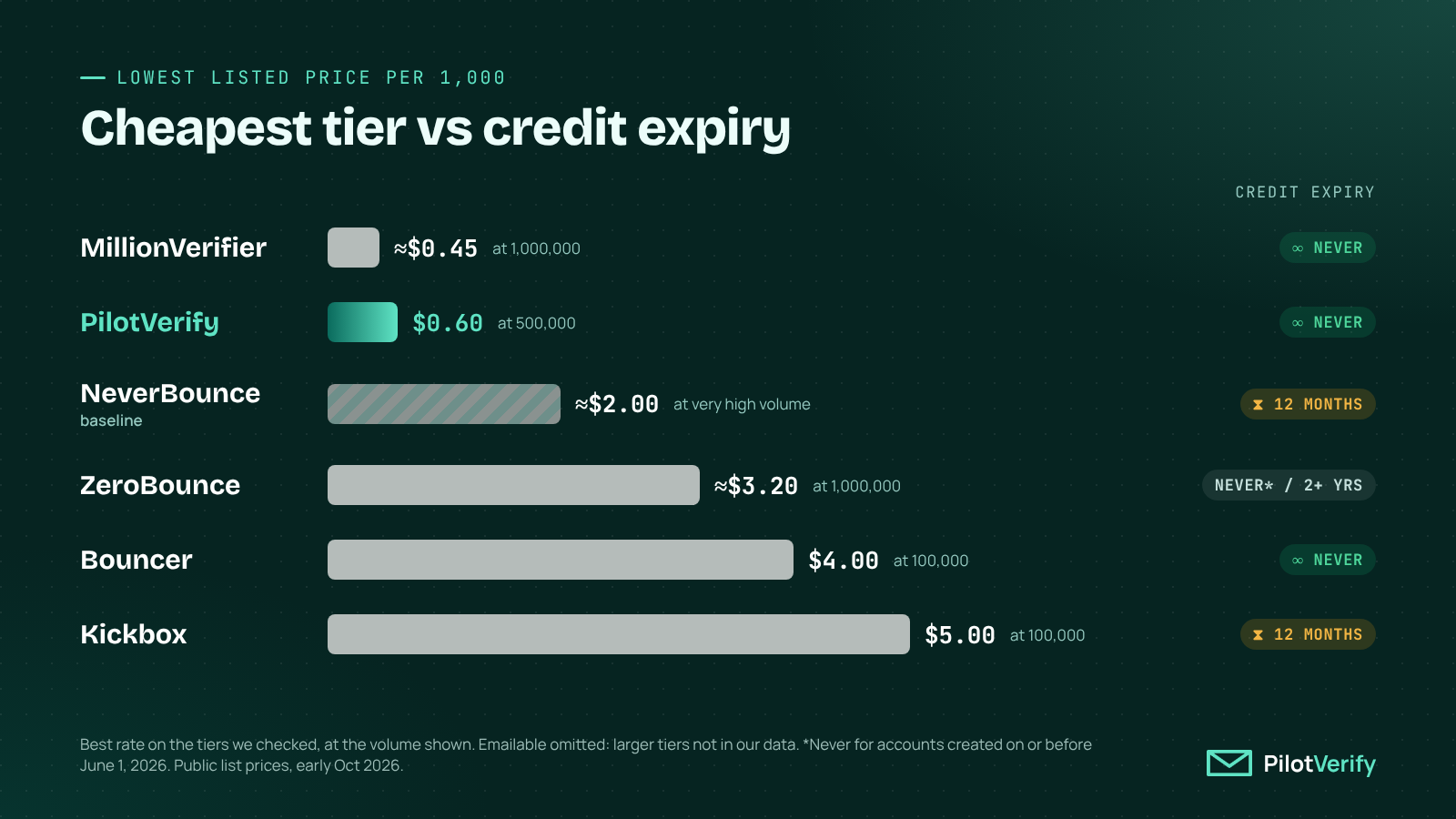
Figure: Lowest listed price per 1,000 on the tiers we checked, ranked from MillionVerifier (≈$0.45) to Kickbox ($5.00), with each vendor's credit-expiry terms.
Master Comparison Table: NeverBounce vs 6 Alternatives
"Entry" is the smallest listed pack. "Lowest listed" is the best per-1,000 rate on the tiers we checked, at the volume shown.
| Service | Best for | Entry pack | Lowest listed per 1,000 | Credit expiry | Free credits |
|---|---|---|---|---|---|
| NeverBounce (baseline) | CRM sync | $8 / 1,000 | ≈ $2.00 (very high volume) | 12 months | ≈ 1,000 (trial) |
| PilotVerify | Pay-as-you-go, no expiry | $25 / 5,000 | $0.60 (500,000) | Never | 1,000 |
| ZeroBounce | Full deliverability suite | $39 / 2,000 | ≈ $3.20 (1,000,000) | Never (older accounts) / 2+ years (newer) | 100 / month |
| Bouncer | EU / GDPR | $8 / 1,000 | $4.00 (100,000) | Never | 100 |
| Kickbox | Polished UI, Sendex | $5 / 500 | $5.00 (100,000) | 12 months | 100 |
| MillionVerifier | Cheapest bulk | ≈ $37–39 / 10,000 | ≈ $0.45 (1,000,000) | Never | Check site |
| Emailable | Clean UX | ≈ $38–50 / 5,000 | Check site | Check terms | 250 |
Per-1,000 figures are pack price divided by thousands of credits, for example $300 ÷ 500 = $0.60 and $449 ÷ 1,000 = $0.449.
Which NeverBounce Alternative Fits Your Situation?
· You clean lists a few times a year: choose a vendor whose credits never expire — PilotVerify, Bouncer or MillionVerifier.
· You verify signups in real time: PilotVerify's sub-100ms average response and skipSMTP option suit inline checks.
· You clean millions of rows and price is everything: MillionVerifier.
· You want verification inside a bigger deliverability platform: ZeroBounce, or PilotVerify's Complete bundle at $39/mo (10,000 credits a month plus DMARC and blacklist monitoring).
· GDPR posture is top of the checklist: Bouncer.
· Your team lives in the dashboard: Kickbox or Emailable.
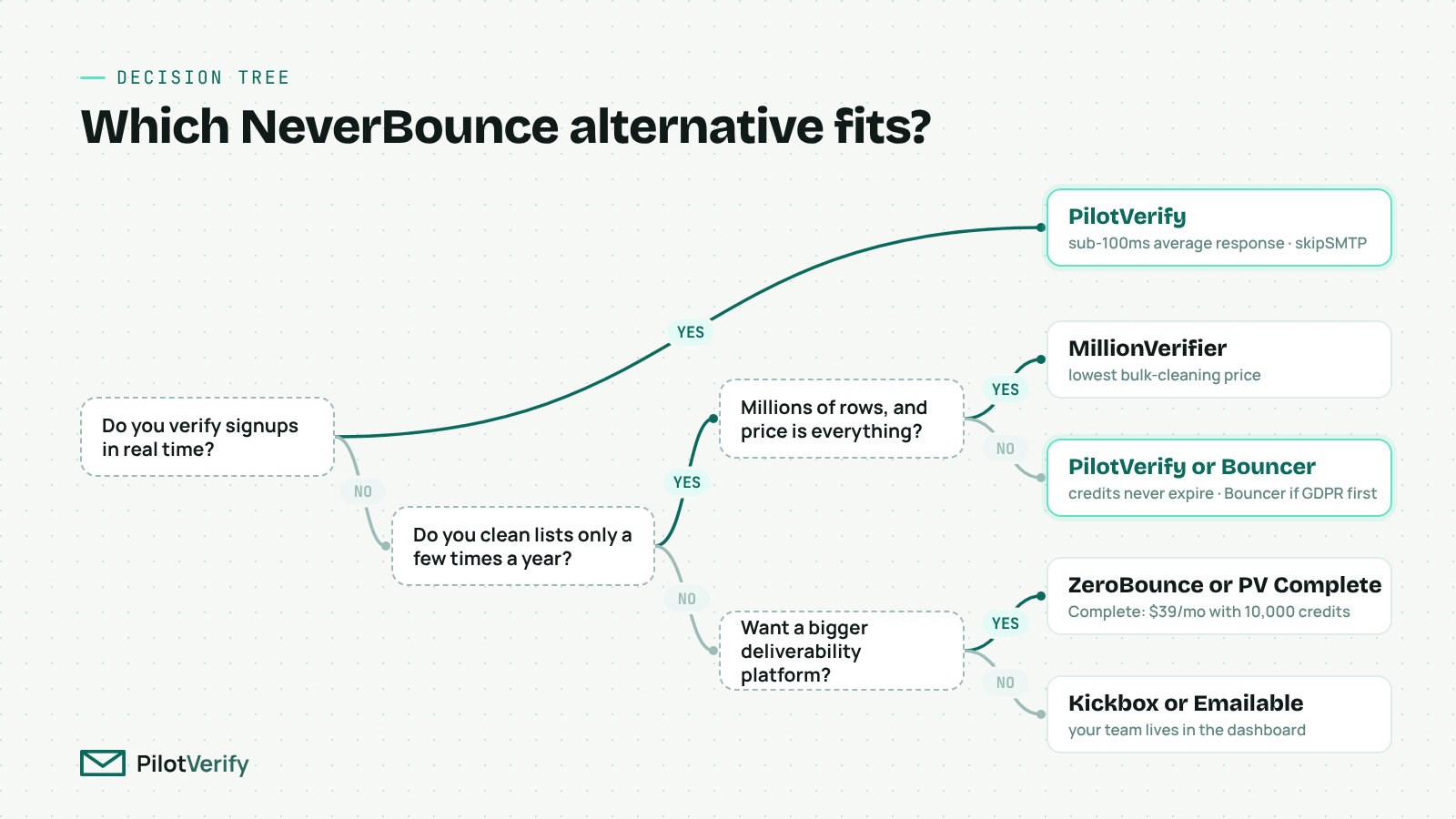
Figure: A decision tree from "Do you verify signups in real time?" to a recommended vendor at each leaf.
How to Switch Without Losing Data Quality
Moving vendors is mostly a matter of re-pointing one API call and re-checking your current list. A simple sequence:
· Use up or note any remaining NeverBounce credits before they expire.
· Export your list and verify a sample with the new vendor's free credits.
· Compare how each tool labels risky and catch-all addresses on that sample.
· Swap the API call in your signup flow, then run the full list through bulk validation.
If PilotVerify is your pick, re-verifying an exported list with the batch endpoint looks like this in Python:
import requests

API_KEY = "YOUR_API_KEY"
URL = "https://pilotverify.net/api/validate/batch"

def verify_list(emails):
    results = []
    for i in range(0, len(emails), 1000):          # max 1,000 per batch
        chunk = emails[i:i + 1000]
        r = requests.post(
            URL,
            headers={"Content-Type": "application/json", "x-api-key": API_KEY},
            json={"emails": chunk, "skipSMTP": False},
            timeout=120,
        )
        if r.status_code == 401:
            raise RuntimeError("Missing or invalid API key")
        r.raise_for_status()                       # e.g. insufficient credits
        data = r.json()
        results.extend(data["results"])
        print("Credits remaining:", data["creditsRemaining"])
    return results

keep = [x["email"] for x in verify_list(my_emails) if x["status"] == "VALID"]
💡 Developer Tip: Don't drop RISKY results automatically. Check isCatchAll and isDisposable on each result, send catch-alls to a separate segment, and suppress disposables. Our bulk email validation guide covers the full workflow, and the request formats are in the API docs.
Lists decay steadily — commonly estimated at around 20–25% a year — so whichever vendor you choose, plan regular re-verification and aim for a bounce rate under 1% (under 2% is the healthy ceiling).
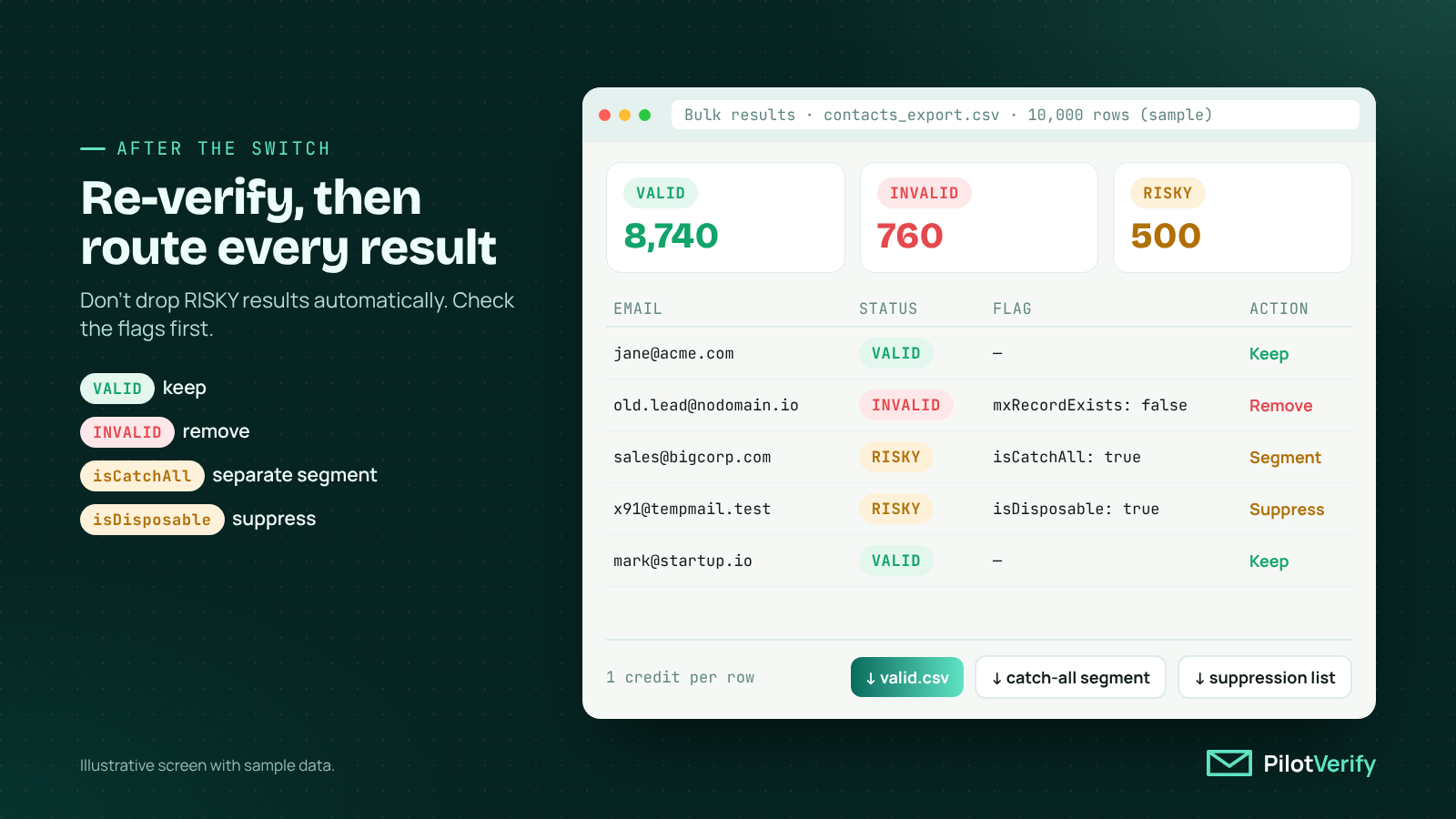
Figure: An illustrative re-verification run on a sample list: keep VALID, remove INVALID, segment catch-alls and suppress disposables.
Frequently Asked Questions (FAQ)
Q: What is the best NeverBounce alternative?
A: It depends on your use. For pay-as-you-go credits that never expire plus a fast real-time API, PilotVerify. For a full deliverability suite, ZeroBounce. For the lowest bulk price, MillionVerifier.
Q: How much does NeverBounce cost?
A: Pay-as-you-go is $8 per 1,000 emails, with volume tiers down to about $0.002 per email at very high volume. The Growth plan is $49 per month for up to 10,000 emails.
Q: Do NeverBounce credits expire?
A: Yes. Pay-as-you-go credits expire 12 months after purchase.
Q: NeverBounce vs ZeroBounce — which is cheaper?
A: At 5,000 emails NeverBounce's pay-as-you-go rate works out to $40, while ZeroBounce's 5,000 pack is $69. ZeroBounce credits last longer, though. We cover this in detail in a dedicated head-to-head post.
Q: Which email verification service has credits that never expire?
A: Of the services here, PilotVerify, Bouncer and MillionVerifier state that credits don't expire. ZeroBounce credits never expire for accounts created on or before June 1, 2026.
Q: Can I test PilotVerify before switching?
A: Yes. You get 1,000 free credits on signup, and you can check single addresses with the free email verifier. Compare packs on the pricing page.
Choosing Your Next Email Verification Service
NeverBounce remains a solid product, especially if its CRM sync is central to your setup. If credit expiry or per-email price is what is pushing you to look around, every alternative here fixes at least one of those problems. Shortlist two, run the same sample through both using their free credits, and decide on real results rather than headline claims.
Try PilotVerify Free — verify 1,000 emails with credits that never expire at pilotverify.net